Sketch: Leda by Leonardo DaVinci
A safe place to ask those parenting questions we have & receive unconventional answers.

Sketch: Leda by Leonardo DaVinci


How do you teach a little one-about 8 months old-how to stay away from things like wires? I want my little one to be able to go where she wants in the house, but of course she's drawn to things she shouldn't have-like all of the wires under the computer. And I want her to learn that there are somethings that shouldn't be played with, even if they look like fun. Is there anyway to teach her to leave these things alone? Or should I just succumb and completely baby proof the entire house? Now that she's mobile, she doesn't even play with her toys-she only wants to climb and crawl to things she shouldn't. Any clues on how/when to transition kids from their crib to a toddler bed? Ben (21 months) climbed out of his crib the other day. I'm hoping that the fall scared him enough not to do it again, but I'm starting to think toddler bed now especially since his little brother will be wanting the crib in the next few months anyway. Also, have you ever used a crib tent? What do you think of those?
Timing is hard to answer. Because the answer is - when both your child and you are ready. Just because he's ready, doesn't mean you are.
So, if he's climbing out of a crib - he's really getting close. But, if you aren't ready, then you can always lower the bar so that its simply safer to get out on his own. As for the crib tent - I have no idea!! It sounds like a great fix to prolong crib time and keep your little one safer - but I have no first hand knowledge - I don't even know who to ask. Sorry, I'm letting you down.
You have to be ready too, because transitioning takes a lot of effort.
So, first start talking about it. Start pointing out friends that sleep in beds. Talk about your bed and how much you love your bed. And after a week of "prepping" conversations - ask if he wants one.
Then I would start with a trip to buy sheets (of course you need to decide if twin or toddler bed is what you want ahead of time and I don't really have an opinion). You want your child to be so excited about the transition. And if you aren't really keen about Transformer sheets then get a Transformer pillow case at least. You want them to feel like they have made the decision - not that it is thrust upon them.
Now, you probably know if your child is good at change or struggles with it - how does he do when you leave him with a babysitter? or at nursery? If he isn't great at it, then you will really have to ease him into the new bed. You will have to camp out on the floor the 2nd, 3rd, and 4th night (but let him try the first night - who knows it could be great!)
The hardest thing about a real bed is the freedom. The freedom to get up and walk around. The freedom to come and get you. So, just be prepared for two weeks of pushing the limits. He'll test you. And I would suggest...that every time he gets up - you immediately take him right back in. No words, not really warm, just the action. It may take 15 times. But, if you stick with it, he'll learn. But, try whatever system for a good two weeks before giving in!
What am I forgetting?
Painting: The Boyhood of Raleigh by John Everett Millais
How do you help a 15 month old baby {my daughter} that could easily walk on her own, but doesn't have the confidence yet learn to walk? I don't mind {ok, I love it} that she likes holding my hand, but do sometimes wonder when she will walk by herself.
What activities can I be doing with my daughter (she will be three in October) now that are fun and educational? Shapes, Colors, Letters, Numbers - just make sure they are fun! I have a few more ideas - if people like this one...what do you do?
Let's face it - by the time I get to the park I'll I want to do is sit back and let them play. Anyhow, what do you think is the right thing to do?
Painting: Snap the Whip by Winslow Homer
Silk Screen: Les Oiseaux by Henri Matisse
My little one has run a low grade fever the last couple of days and I'm conflicted between taking him to see the doctor or waiting it out. Also, when he's a little bit sick like this should I allow him to cry it out in the night or should I go to him? Help!
Give me traveling tips...Tips for traveling on airplanes, in cars, on buses, on trains...traveling without losing my mind, my temper, or my child and without without giving fellow travelers an hour-long high-pitched serenade accompanied by kicks to the back of the seat.
What do you do for diaper rash...any tricks I don't know?
I have a question for you... is there a method to the madness of what to teach a kid when? My child knows most of his animals and body parts and I'm trying to decide if there is something I should focus on teaching him next? Seems like colors, numbers or the alphabet should be next.
I'm having trouble with the concept of "time-outs" with my almost 3-year old. I feel like I don't have many extra rooms in my apartment to make her stay in, so where do I put her? She won't seem to stay put on a chair, and there are so few corners to stick her in. How do I make her stay there? I like the Supernanny suggestion of a time-out for however many minutes they are old. I just don't know how to enforce it. Do you use time-outs or something else?
I remember when you had your first, you were finding all sorts of household items that you could play with (i.e. making shapes on the floor with yarn). What other sorts of games/toys have you made up with run-of-the-mill things that your kids have enjoyed? or things they haven't enjoyed? 6. As the get older - a purse or bag filled with random items is genius: the free credit cards that are fake you get in the mail, an old cheapy Casio watch, a small flashlight, key ring (with keys is the best). Baby's like to pull stuff out of things. And older children like to tote around a bag as well.
7. Fill a pot with potatoes and let a baby pull them out (do a sample run for them first). The "pull out" phase comes before the "put in" phase. So, when a baby can sit this starts to become a fun game.
What "free" ideas do you have?
Painting: Child with a Dove by Pablo Picasso
I have a screamer!!! She's got a loud high pitch scream which she now does for fun, when ever her brother is near, or if she doesn't get her way. She's 18 mo. and all my tactics seem to be failing. Please help my ears and sanity PLEEEEEASE.....
Do Not's
1. Don't give up. It takes ten (10) times of eating any food before we can truly determine if children like something (ok, I'm sure they wouldn't appreciate this if they knew, but there are so many new things, not only taste but texture, etc. to familiarize their little tongues to).
2. Don't worry about starving them. If they don't eat enough at dinner they will make it up the next day (of course children are much crankier without food, so I try not so much for their stomachs but for their moods). And literally their appetites are so small sometimes, but the instant they are growing they will eat so much better. So, worrying isn't worth it.
3. Don't leave them in their high chair too long - it makes crazy associations with food and feeling stuck or unhappy - so just be aware of this.
Do's (these are all debatable, but I'm all about new ideas, my personal favorite is last on the list)
1. Get creative. Kids like a challenge and something exciting, so really plate your meals in an exciting way. Instead of cutting their sandwich into four squares, cut them ragged and pile them high...a Ham Sandwich Mountain...put a dinosaur or a ballerina on top. Or, turn the squares into diamonds and present the sandwich as a butterfly - the favorite meal of fairies.
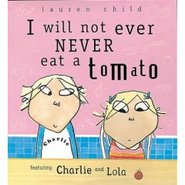
2. Name the food something different - if you've read I Will Not Ever Never Eat a Tomato (book cover on the side) they call tomatoes- moonsquirters; potatoes - cloud fluff; peas-green drops from Greenland. Boys love nasty Halloween phrases - guts, eyeballs, you know, the words that make us queasy.
3. Soup - Let them use a straw to drink it - Won Ton Soup, Gazpacho, Chicken Noodle...if they feel like it isn't aloud it will make it more fun.
4. Dads have the biggest influence on this sort of thing - if they eat something and love it - talk about how delicious broccoli is and how they know its why they are so tall and strong...it will make a huge difference.
5. Playing with their food - usually this is a sign children are finished. But for some kids if they can play with it long enough, they will absentmindedly put something in their mouth - so just be patient enough to learn which category your child fits in.
6. Dipping is the dream solution. Most kids love the process of dipping. With most meals, I like to have a "pool" for them to dip in - usually a separate bowl. So, a "pool of syrup" for most breakfast items - including fruits they aren't great at eating - kiwi, mango, passion fruit, blue berries. A "pool of ketchup, ranch, or Italian dressing" is also genius for tomatoes, cucumbers, celery, whatever else. For some magic reason, dip, dip, dipping is a wonderful tool.
7. Eat with them. A lot of times meals are a chance to get errands done, but if they are having a hard time eating, I would change your habit for a few weeks. Just to send this message - what you eat is so important I want to sit here and watch you do it!
8. Finally, and I am not embarrassed to admit this - candy. That's right - straight up bribery. I have been doing this lately and my two year old is eating foods he never would have dreamed of trying (because it is always the trying that's hard). I literally sit next to him with an unseen pile of jelly beans. And for every bite of something I ask him he can get a jelly bean. It goes like this, "Chase if you eat that asparagus you can have a jelly bean." Half way through eating he wants the jelly bean, "Chase you have to finish eating the asparagus. Chew, chew, chew and swallow it...and then you can have candy!" He has eaten so many things - and he is getting over the fear of it. So now, when he sees a green bean, he knows he has eaten it and he tries it again without the candy...not always. But, a lot! I know many people would roll over in their grave, but hey, its working.
What works for you?
Painting: Apples, Peaches, Pears, and Grapes by Paul Cezanne
I had no idea that I was guilty of this. I wouldn't dream of calling my kids lazy or dumb - but here's the thing: labeling doesn't only apply to negative labels - it applies to positive labels as well.
Jeffrey Holland said, "You may say most positively that "Susan is pretty and Sandra is bright," but all Susan will remember is that she isn't bright and Sandra that she isn't pretty." This is why labeling is dangerous - it seems to pigeonhold a child.
For example, here are phrase and labels I have been guilty of using...
"You are such a great helper."
"What a great artist you are!"
"You are so athletic."
"Wow, you are such a smart boy."
Ok, I know what you are thinking, if I can't say those to praise my child, what can I say? This is what I learned...it is much more powerful to describe the action. So instead of saying something about being a helper, try describing whatever they did to help..."You are so great at putting your toys away in the basket when I asked you. I really needed your help. Thank you." Or when they bring you a finished art project, "Wow, I love the way you colored such thick lines here - and I love the circles over in this corner - I love this color you chose!"
What this does is help children understand what makes them so great! It helps them identify and accurately process their actions. It will help them in school and in life. I know that even as adults we make this mistake, we may be the "creative" friend - but when we aren't feeling creative, we can feel without purpose.
I still say "helper" and fall into labels - but I have really seen that it is harmful. A child who thinks he is a "great writer" - may find himself confused when writing isn't easy for him when he's in school - but a child that knows he is "great at using adjectives" will understand his own talents.
It takes more time - but its pretty great! Thanks to Cheryl for some of these great thoughts!

And then once the crib is the happiest place, focus on the first nap. This means as soon as your baby wakes up watch them like a hawk, as soon as they yawn (not the wake up yawn) but the first sleepy sign...rubbing eyes, yawning, sometimes sadness...put them down. This may be an hour after they are up - but if you can get a first nap in right away - the second nap and bedtime will be so much easier.
I am a fan of wrapping little babies, and older babies I sing a little song or something - the same thing every time to signal - nap time. Some babies like music - but some its too stimulating - so just be wary.
Novels are written on this subject - so this is just the beginning. And its almost ironic because although my kids really love nap time and sleeping - this week it hasn't been so ideal. My two year old learned to escape from the bed and is in the middle of getting up and getting up. I'm in the midst of a calm - return to bed - no extra cuddles, just persistence project. Sigh...so for me - be sure and add ideas for toddlers who get up and up and up...I have a few others, but my general rule of thumb - is if you do something consistently for two weeks with no luck - its probably not a match for your child...and I'm at seven days and counting!
Painting: Sleeping Child Covered with Blanket by Henry Moore